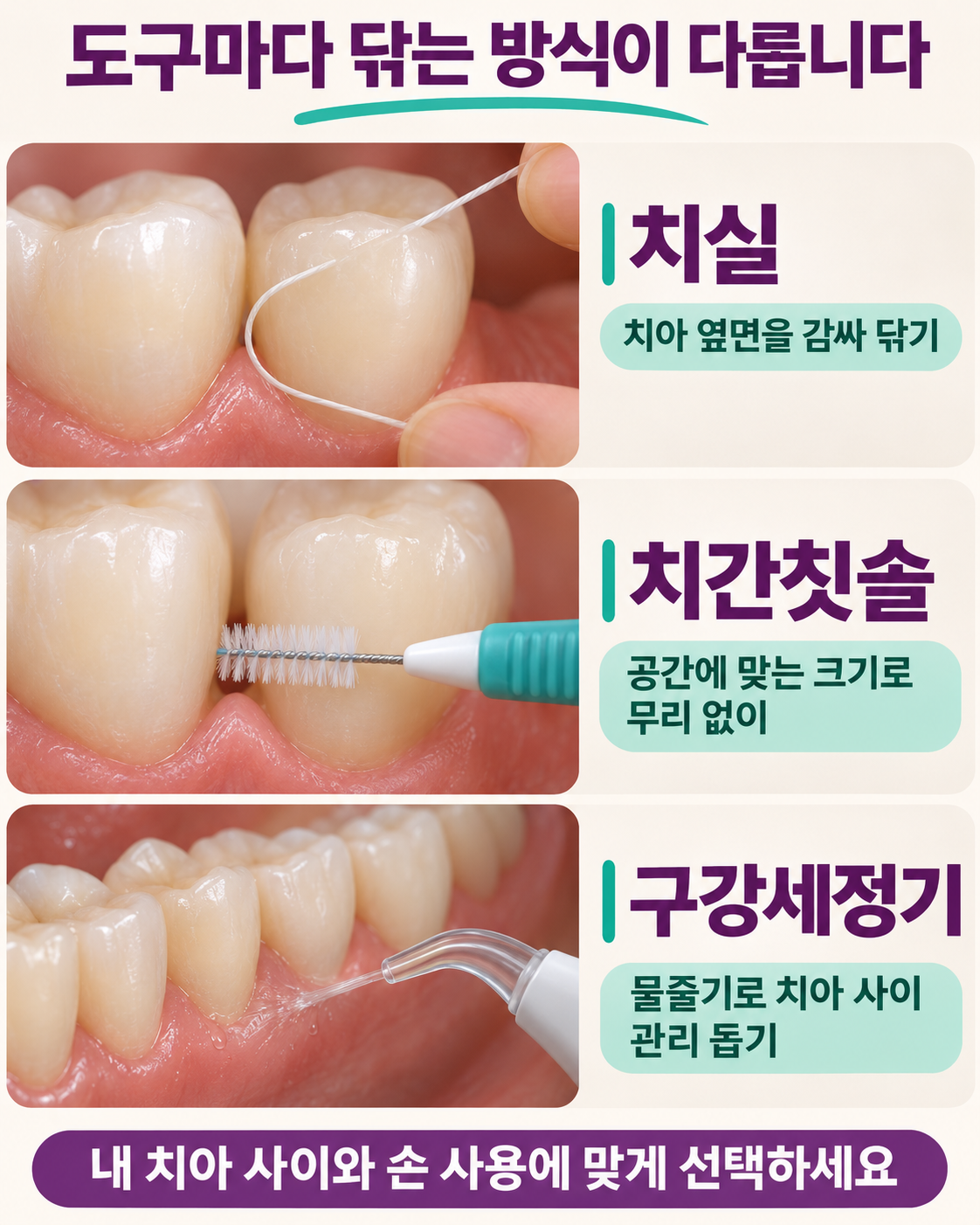
You do not need to use all three tools on every tooth. Consider floss for narrow spaces, or an appropriately sized interdental brush where there is room for its bristles. Water flossers, such as Waterpik, are an option when handling floss is difficult or restorations make access harder. Different areas in the same mouth may need different tools, and brushing is still necessary whichever tool you use.
Removing trapped food does not finish cleaning the tooth surfaces
When a piece of meat comes out after a meal, it is easy to feel that cleaning is complete. However, cleaning between the teeth also targets plaque that may be hard to see. Plaque is a sticky film of bacteria that can remain on the sides of teeth and along the gumline where a toothbrush does not reach well. Taking out a cleaning tool only when food gets stuck makes it difficult to care for these areas consistently.
The American Dental Association recommends cleaning between the teeth every day. Before deciding whether you need all three types of tool, work out which tooth surfaces need cleaning and how to reach them. Yonsei Goun Miso Dental Clinic, Sinchon Branch 1 provides information on gum treatment and scaling. If you seek advice about gum discomfort, also mention the tools you use and the areas you find hard to clean.
For tightly spaced teeth, keep the floss against the side of each tooth
If teeth are closely spaced and there is no room for a small brush, floss may be an option. Do more than simply pass the floss between the teeth and pull it out. Gently guide it through the contact point, curve it into a C shape around one tooth, and move it up and down along that tooth's side. Clean the facing surface of the other tooth in the same gap separately.
Snapping floss down toward the gums when it is hard to pass through can injure the tissue. Do not force it. If it keeps catching or hurts to use, ask a dentist to check the area and your technique. Floss with a handle may be an option if wrapping floss around your fingers and reaching the back teeth is difficult. Even with a handle, check that the floss touches both facing tooth surfaces.
Choose an interdental brush that fits the space
An interdental brush uses small bristles to clean between teeth. It can be used where there is space near the gums, and its size needs to suit that space. Notice whether it passes through too loosely or needs force to enter. The bristles should touch the tooth surfaces while the brush can still be inserted gently. It is not a tool for forcing open a space that is too narrow.
If the spaces between front and back teeth differ, one brush size may not clean them all effectively. Buying one small size does not mean it will fit every area. Ask your dental team to show you which size to use in each location, and note both the product name and size. If you are unsure of the angle, trying it with guidance can be more useful than hearing instructions alone.
A Waterpik is an option when floss is difficult to use
Water flossers, including Waterpik, use a stream of water to remove food particles and plaque between and around the teeth. The American Dental Association describes them as an option for people who have difficulty handling floss or who find flossing difficult because of braces or a fixed bridge. Using a water flosser does not, by itself, mean that someone's oral care is inadequate.
A fresh feeling or the amount of food washed out cannot tell you whether cleaning is thorough. If you have been advised to use an interdental brush in a particular area, point to that area and ask whether a water flosser can replace it there. Check the product instructions and ask where to direct the stream around your restorations. There is no basis for assuming that higher pressure or a particular product is better for everyone.
Brushing with fluoride toothpaste is still necessary when you use a water flosser. Hardened tartar should be removed by a dental professional, not with a stream of water or floss at home. Buying a new cleaning device and having your gums assessed are different things.
Check areas around restorations and sites that bleed
If you have implants or a bridge, location alone is not enough to decide, for example, that every back tooth needs an interdental brush. First identify the areas you need to reach, including connected sections and the undersides of restorations. At your consultation, point out the restoration and ask whether to use floss, an interdental brush, or a water flosser around it, and in which direction. For interdental brushes used around implants, also check the product's material and intended use.
Bleeding is not a reason to abandon all cleaning between the teeth, nor to scrub the same area harder in the hope that more cleaning will fix it. Inflamed gums and rough use of a tool can both cause bleeding; bleeding alone cannot distinguish between them. If bleeding recurs or cleaning is painful, ask your dentist to check both the tool and how you use it. If your gums become very swollen and painful or a tooth feels loose, contact the clinic promptly to ask when you should be seen.
Bring the tools you use to your next visit
Before choosing a product, identify what you currently find difficult. Saying 'I cannot reach my lower left back teeth' or 'The brush fits this gap but not the next one' is more specific than saying only that flossing is difficult. Bring your usual tools or a photo of their packaging, and choose the questions below that apply to you.
- Which tool and size should I use in this space?
- Could you watch me try it and check whether it reaches the tooth surfaces properly?
- Am I missing any areas underneath or behind my restorations?
- Please show me which areas can be cleaned with the water flosser I currently use and which need additional care.
Common Questions
Do I need to buy interdental brushes if all my teeth are closely spaced?
Do not force a brush into a space that cannot accommodate it. Consider floss for narrow areas. If handling it is difficult, ask about other forms of floss or a water flosser. Not everyone needs all three types of tool.
Should I clean between my teeth before or after brushing?
The American Dental Association emphasizes thorough daily cleaning without requiring a particular order. The UK NHS advises flossing before brushing. Rather than skipping cleaning because of uncertainty about the order, choose a time you can maintain consistently and follow any individual instructions you have received.
References
- American Dental Association (ADA) — Floss and Other Interdental Cleaners ↗
- American Dental Association (ADA) — How to Floss ↗
- American Dental Association (ADA) — Water Flossers and Cleaning Between Teeth with Water ↗
- Australian Dental Association — Choosing and Using Floss and Interdental Brushes ↗
- UK National Health Service (NHS) — Keeping Your Teeth Clean ↗
- National Institute of Dental and Craniofacial Research (NIDCR) — Periodontal (Gum) Disease ↗
- UK National Health Service (NHS) — Gum Disease and Symptoms That Need Dental Care ↗
- Yonsei Goun Miso Dental Clinic, Sinchon Branch 1 — Gum Treatment and Scaling ↗
Alongside the consultation questions in Tooth Notes, explore our clinic's information about related treatments.
Discussing gum care at Sinchon Branch 1
Yonsei Goun Miso Dental Clinic, Sinchon Branch 1 provides information on gum treatment and scaling, with Dr. Hong Seong-bae responsible for gum care. If there are areas you struggle to clean or sites that repeatedly bleed, discuss them along with the tools you currently use.
The clinic is near Exit 8 of Sinchon Station on Subway Line 2. When booking, mention any gum symptoms and whether you would also like advice on your usual oral care routine.
- Address
- 5F, Taeyoung Building, 88 Sinchon-ro, Mapo-gu, Seoul
- Dental Care Inquiries
- 02-3143-6321
Medical Information & Disclaimer
This article provides information to help you understand dental care in general and prepare for a consultation. It does not replace an individual diagnosis or treatment. Suitable treatment options, duration, outcomes, and side effects may vary depending on your oral and overall health. If you have symptoms or are deciding on treatment, please consult a dentist.
The explanatory images in this article are AI-generated conceptual illustrations, not photographs of actual patients or treatment.