A bruxism appliance is used to reduce damage by preventing direct contact between the teeth. Wearing one does not mean that grinding or clenching activity has stopped. Management depends on whether the teeth need protection, whether there are other causes of jaw pain, and whether daytime habits or sleep problems also need assessment.
Consider both noisy grinding and quiet clenching
The term teeth grinding may bring to mind teeth moving from side to side and making noise. Bruxism also includes clenching the teeth or tensing the jaw. Clenching does not always make a sound, so a quiet night's sleep does not rule out a problem.
You may notice yourself clenching while awake during moments of concentration or tension. Activity during sleep is harder to remember, so assessment may draw on sounds heard by someone sleeping nearby, morning jaw fatigue, and the condition of the teeth. Waking and sleeping activity can occur together, but grinding at night does not mean you also clench continuously during the day.
Jaw pain is not always caused by bruxism. Problems with the teeth or gums, the jaw joints, and the surrounding muscles need to be considered separately. Before buying an appliance, explain where and when it hurts; this helps guide the assessment.
Worn teeth alone do not show that severe grinding is still happening
Flattened tooth edges or repeatedly broken restorations are reasons to assess bruxism. However, tooth wear also reflects past activity. Older signs of wear cannot establish that grinding has recently continued at the same intensity. Tooth impressions along the tongue or a line inside the cheek are not diagnostic on their own, either.
That is why tooth wear and recent activity are assessed separately. Distinguish explanations you received in the past from new sensitivity or breakage, and mention whether someone sleeping nearby has heard grinding recently. This does not mean ignoring older wear. It means separating the need to protect the remaining teeth from an assessment of current activity.
Tooth protection and other treatment effects need separate checks
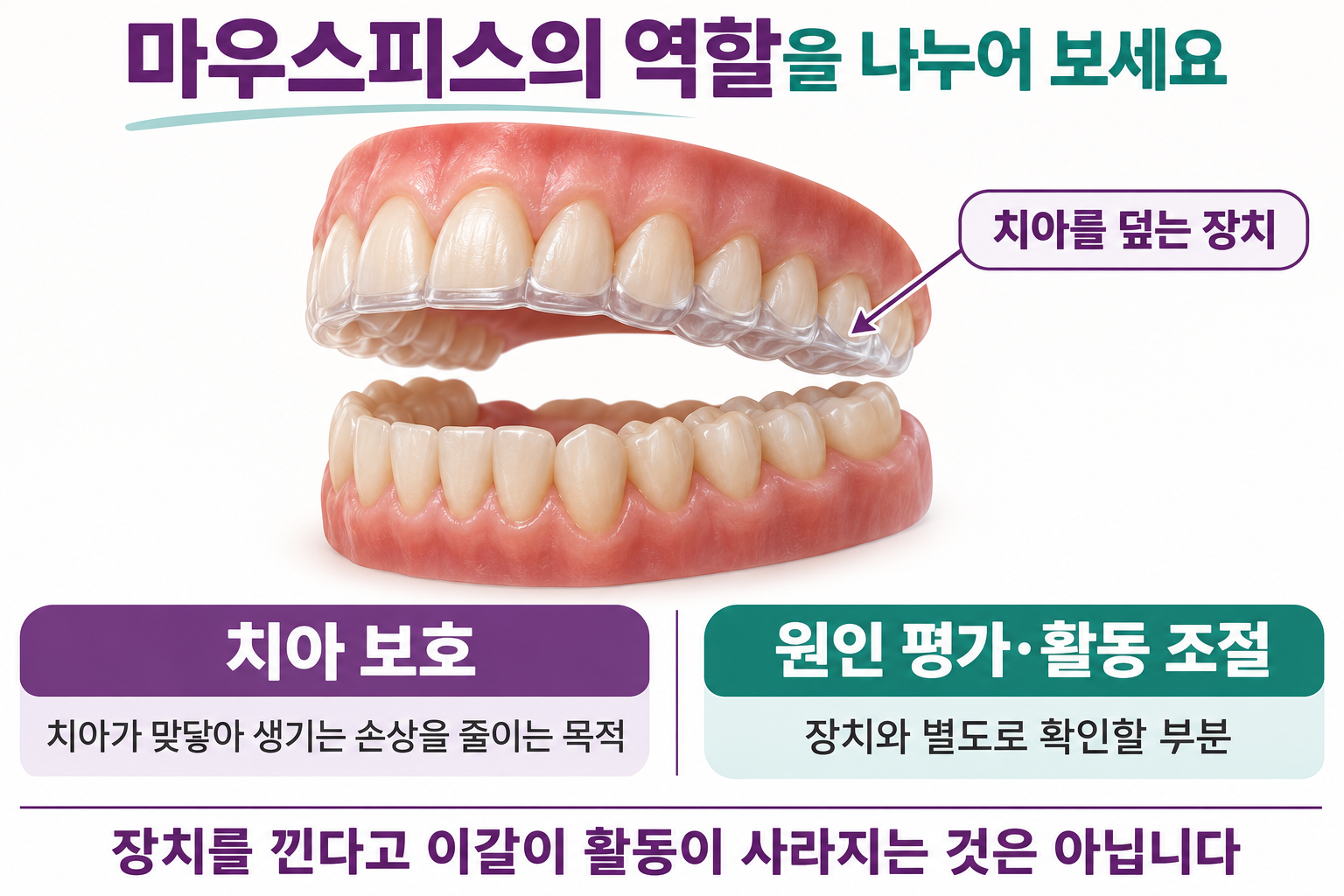
A dental bruxism appliance sits between the upper and lower teeth to prevent direct contact. Its purpose includes reducing tooth damage, and muscle activity may decrease in some people. That possibility is not a promise that everyone's grinding will stop. Changes after using the appliance should be assessed against the original treatment goals.
Protecting the teeth and treating jaw pain are particularly important to distinguish. The National Institute of Dental and Craniofacial Research explains that evidence for appliances improving pain from temporomandibular disorders is insufficient. Pain can remain even when the teeth are protected. If pain continues, the cause and how the appliance is being used need to be reassessed, rather than simply wearing it for longer.
- Tooth protection: Check for new chips, fractures, or other damage.
- Muscle activity: Wearing an appliance does not, by itself, show that bruxism has stopped.
- Changes in discomfort: Describe morning jaw fatigue, pain when chewing, and difficulty opening the mouth separately.
Discuss sleep and medications as well as stress
Bruxism can be associated with sleep problems, alcohol, caffeine, smoking, and some medications, as well as stress. It should not simply be dismissed as a stressful period, or immediately attributed to the way the teeth fit together. Mention recent changes in sleep habits or medications, including the medicine names and when they changed. Even if you suspect a medication, do not stop it on your own; discuss it with the prescribing clinician.
If you snore loudly, have been told that your breathing stops during sleep, wake up gasping, or experience marked daytime sleepiness, ask whether a sleep assessment is needed. Bruxism alone does not diagnose sleep apnea. Nor does the presence of both establish that either one causes the other.
An appliance that protects teeth from bruxism has a different purpose from an oral appliance used for sleep apnea. They should not be considered interchangeable simply because both are worn in the mouth. The need for a sleep study depends on symptoms and examination findings; not everyone who grinds their teeth needs one.
Daytime habits and the fit of the appliance also matter
If you notice daytime clenching, a phone reminder or a note can prompt a brief check of whether you are keeping your upper and lower teeth together. The aim is to practice releasing tension and resting the jaw. This is different from trying to consciously relax during sleep. Regular sleep habits and reducing excessive caffeine or alcohol may also be considered, but lifestyle measures alone do not resolve every case.
Even a night guard bought online needs to be checked for suitability and fit. Sports mouthguards are designed to protect teeth from impact, so their purpose and design differ from appliances for use during sleep. If an appliance presses on your gums or causes pain, stop using it and consult a dentist. Get advice on whether it fits, when to wear it, and for how long, according to the type of appliance and the treatment goal.
Being told that you grind your teeth is not, on its own, sufficient grounds for reshaping teeth or starting orthodontic treatment to change the bite. Before any permanent alteration of the teeth or bite is proposed for temporomandibular pain, the evidence and options that avoid permanent changes should be considered. Restoring a tooth that has already broken is a separate decision about existing damage.
Start by asking why an appliance is needed
Separate the sounds reported by someone sleeping nearby from symptoms you feel yourself. Useful details include morning jaw fatigue, clenching while concentrating during the day, when sensitivity or breakage began, and how discomfort has changed if you already use an appliance. You do not need to guess at details you do not know.
The dental assessment checks damage to teeth and restorations, tenderness in the jaw muscles, the condition of the joints, and mouth opening, then determines whether further evaluation is needed. The temporomandibular joint care guide from Yonsei Goun Miso Dental Clinic, Sinchon Branch 1 likewise describes assessing mouth opening, joint sounds, and muscle tenderness before considering options such as appliance treatment or physical therapy. Not every bruxism consultation calls for the same treatment.
If an appliance is recommended, ask: 'In my case, what is it intended to protect or reduce?', 'How will we assess its effect, and when should it be reviewed?', and 'Do I need another consultation about sleep or medications?' If you already have a broken or sensitive tooth, or pain in your jaw or face, have a dentist assess it rather than substituting an appliance purchase for a visit.
References
- National Institute of Dental and Craniofacial Research (NIDCR) — Bruxism: Symptoms, Assessment, and Management ↗
- UK National Health Service (NHS) — Teeth Grinding and Protective Dental Appliances ↗
- American Dental Association (ADA) — Bruxism and the Difference Between Night Guards and Sports Mouthguards ↗
- International Consensus on Bruxism Assessment — Waking and Sleeping Activity and the Interpretation of Tooth Wear ↗
- National Institute of Dental and Craniofacial Research (NIDCR) — Appliances for Temporomandibular Disorders and Their Limitations ↗
- UK National Health Service (NHS) — Sleep Apnea: Symptoms and Testing ↗
- Yonsei Goun Miso Dental Clinic, Sinchon Branch 1 — Jaw-joint care ↗
Alongside the consultation questions in Tooth Notes, explore our clinic's information about related treatments.
Discussing jaw discomfort at Sinchon Branch 1
Tooth Notes is a dental health information resource run by Yonsei Goun Miso Dental Clinic, Sinchon Branch 1. The clinic provides information on care for discomfort in the jaw joints and surrounding muscles. If you already use an appliance, ask when booking whether you should bring it to the consultation.
- Address
- 5F, Taeyoung Building, 88 Sinchon-ro, Mapo-gu, Seoul
- Dental Care Inquiries
- 02-3143-6321
Medical Information & Disclaimer
This article provides information to help you understand dental care in general and prepare for a consultation. It does not replace an individual diagnosis or treatment. Suitable treatment options, duration, outcomes, and side effects may vary depending on your oral and overall health. If you have symptoms or are deciding on treatment, please consult a dentist.
The explanatory images in this article are AI-generated conceptual illustrations, not photographs of actual patients or treatment.